NVIDIA GB300 NVL72
- Silicon
- 72 Blackwell Ultra GPUs, 36 Grace CPUs
- Throughput
- 1.1 exaFLOPS FP4
- Memory
- 20 TB pooled HBM3e
- Rack power
- 132–142 kW nominal
Handles AI training and large-scale inference: the heavy lifting.

MyelinX pairs dense GPU throughput with event-driven reflexes, cooled by two thermal loops and run by one operating system. The result: an intelligent module that pays back in about 1.9 years and puts its heat to work.
Power, water, grid access, cost and time are all constraints at once. Dense GPU throughput and event-driven inference are deployed as if they were the same workload. They are opposites.
Root cause: components are optimized in isolation and never coordinated. Compute doesn't talk to cooling; cooling doesn't talk to energy; energy doesn't talk to the grid.
MyelinX runs heavy AI workloads and fast-reacting tasks side by side, and sends each job to the tier that fits it best.
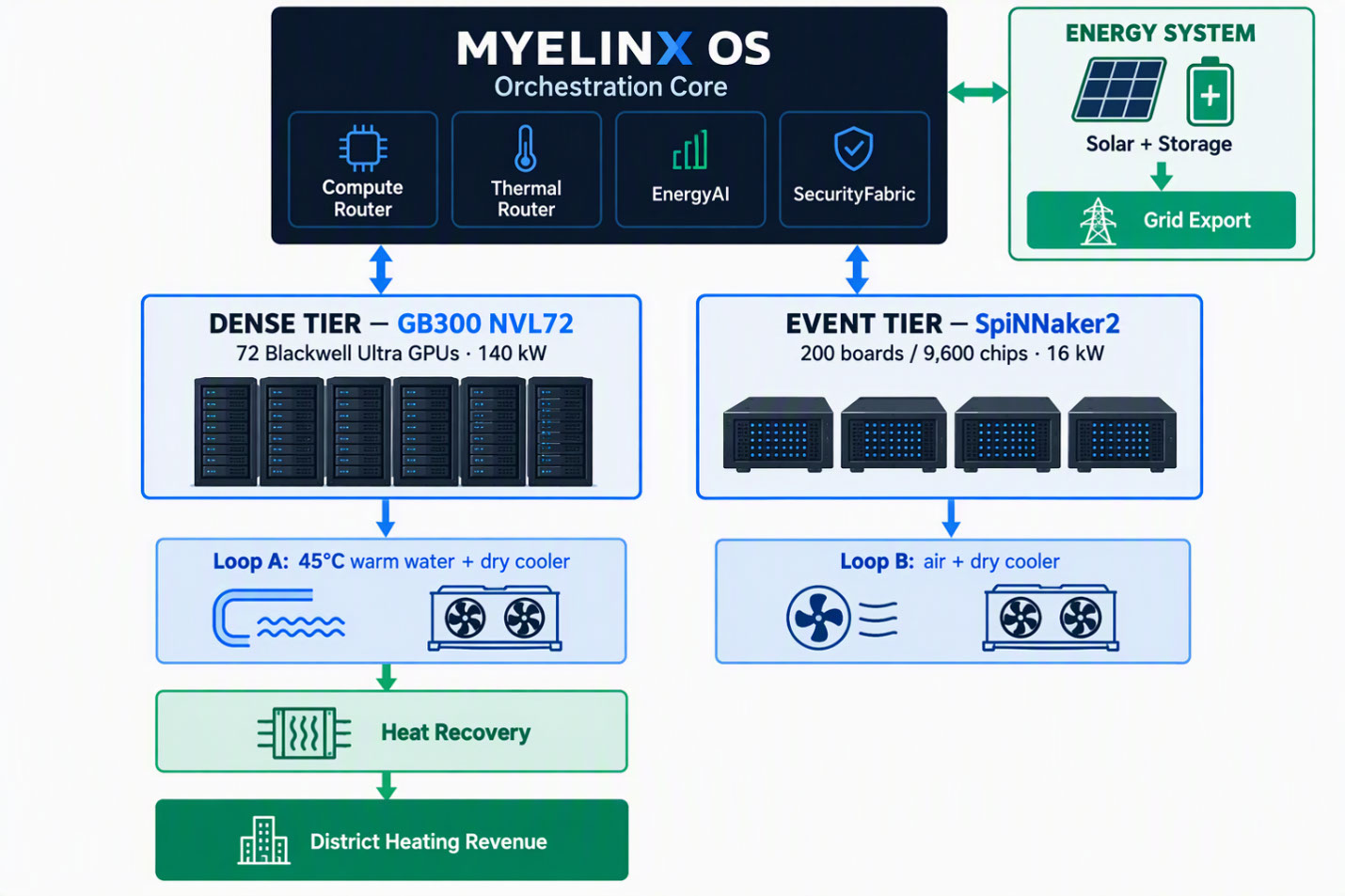
Handles AI training and large-scale inference: the heavy lifting.
Handles instant-response tasks like sensor fusion and robotics control, using far less power.
Captures high-grade heat directly from the chips and reuses it, with almost no water needed.
Recovered heat can warm nearby buildings.
Air cooling kept separate, so it never dilutes the valuable heat from Loop A.
Keeping the two heat streams apart preserves the value of the warmer one.
The OS sends each stream to its best use, such as district heating or space heating, while using almost no water.
It senses, thinks and acts across both compute tiers, both thermal loops and the grid, optimizing for profit, carbon and latency at the same time. Myelin insulates nerve fibers and speeds signals in biology; our protected fabric does the same for infrastructure.
The moat: operational data compounds. Competitors copy hardware; they cannot copy the AI machine learning from 1 TB per day per module.
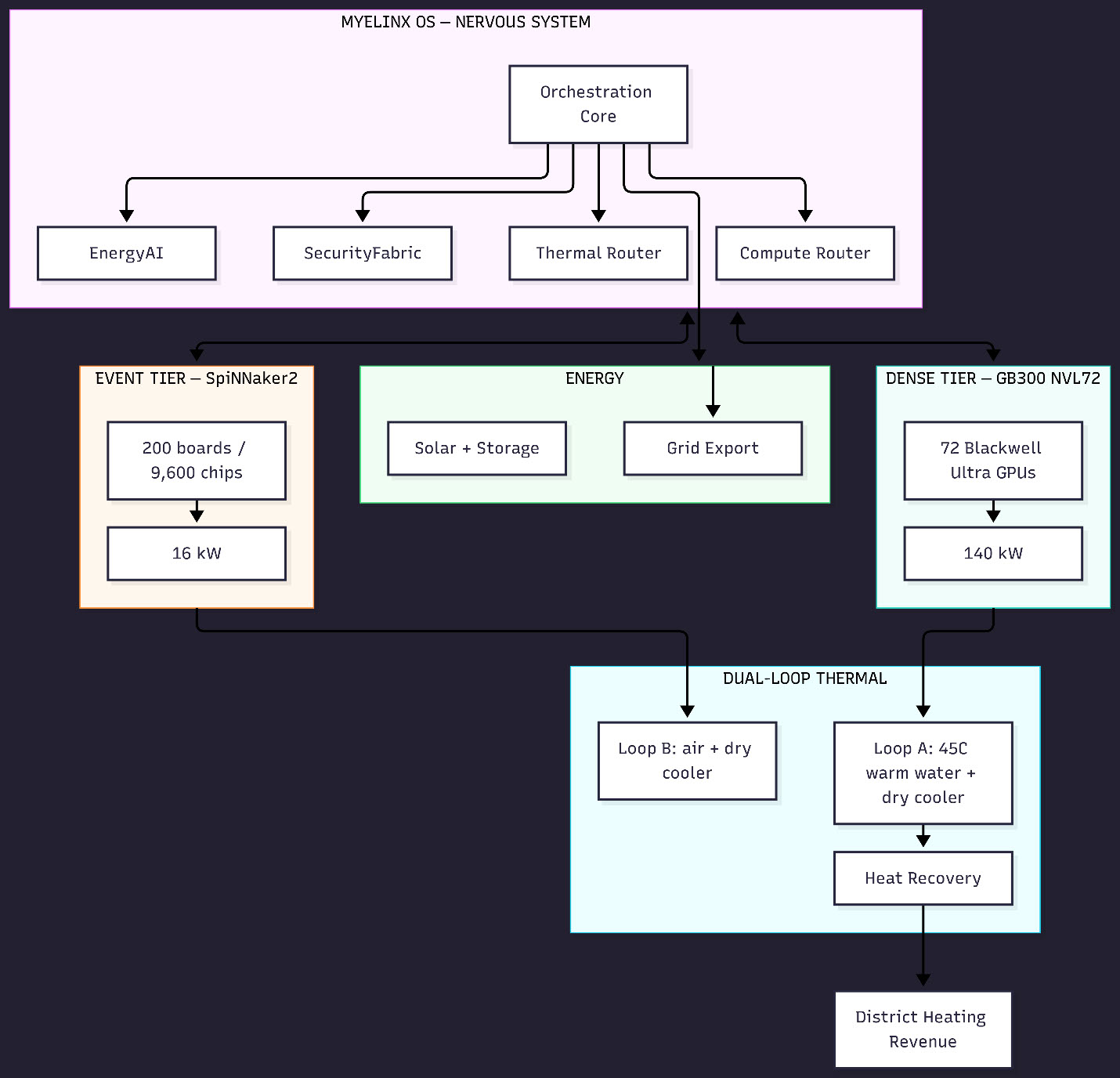
The dense tier carries the economics; the event tier carries the differentiation. Heat, grid services and carbon credits turn waste into income.
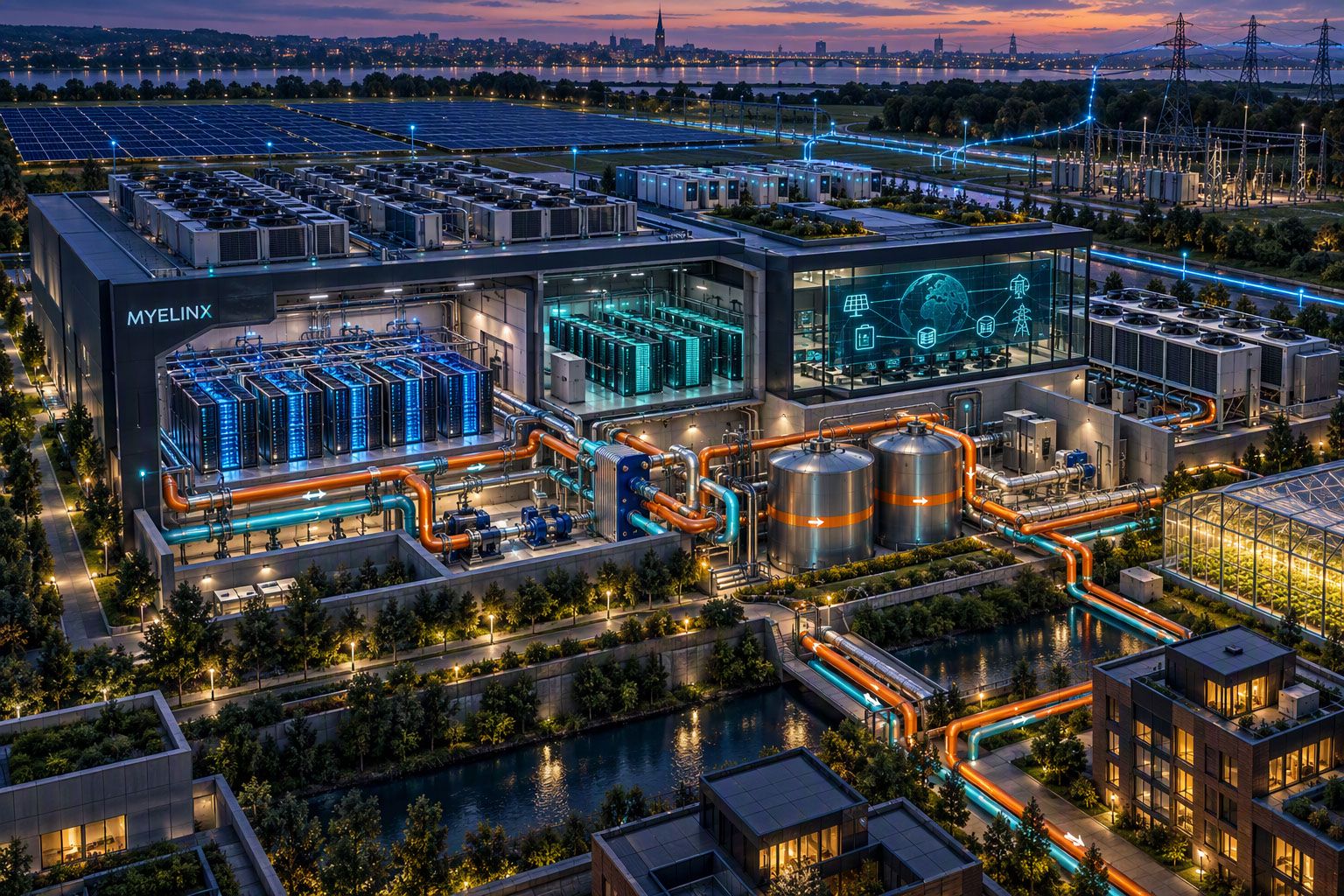
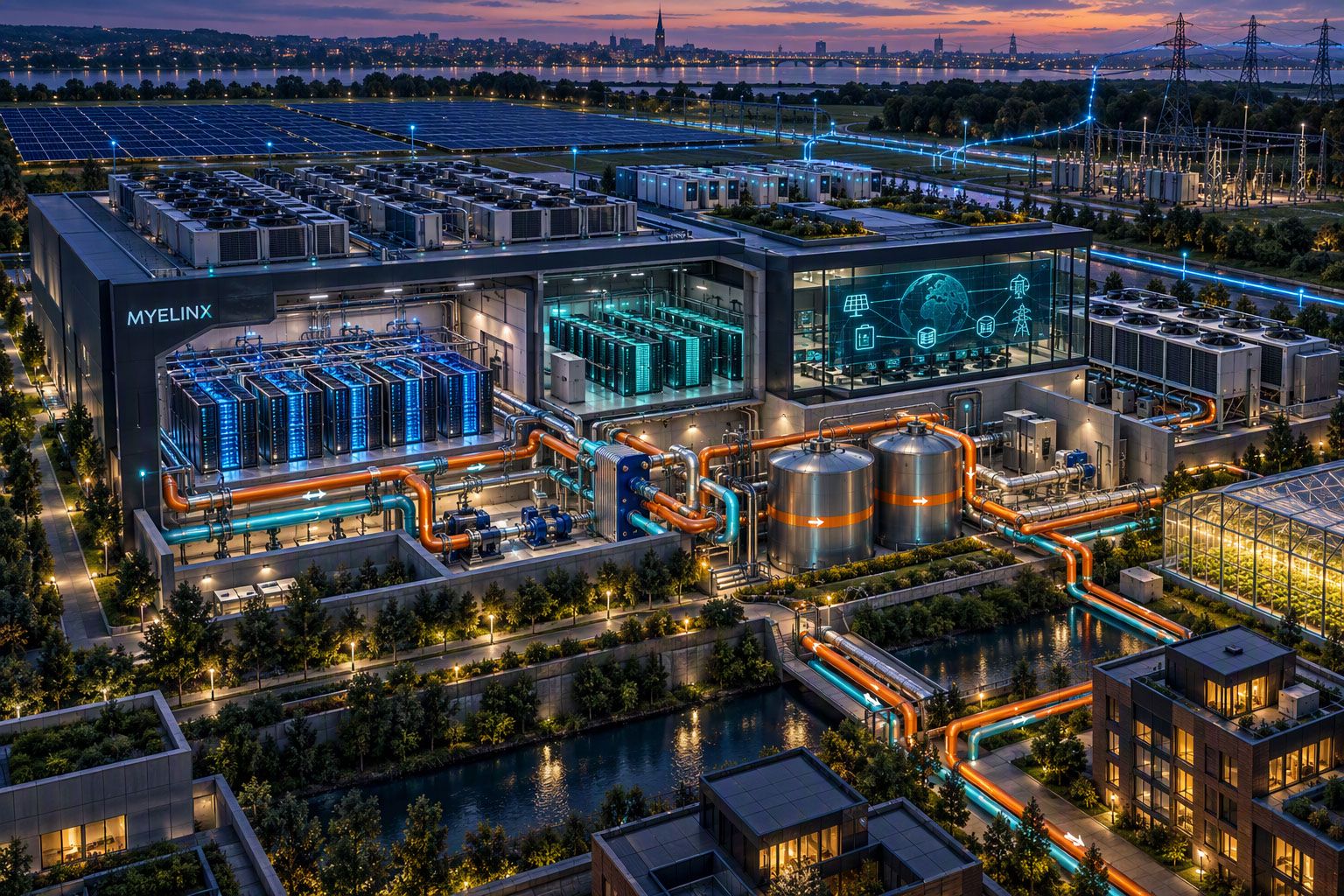
2 MW of solar yields ~3,000 MWh a year against ~1,700 MWh consumed, exporting ~1,300 MWh to the grid. The OS automates coordination so people spend time on judgment, with 90%+ retention targeted.
Full transparency: near-zero water works in moderate climates. Hot, humid sites need backup chillers or a redesign.
A 2031 revenue target represents under 0.2% of an addressable market growing at 39% a year.
First hybrid module live in NYC.
10 modules and profitability.
50 modules across global markets.
Public offering or acquisition.
Target return: 10–15x over seven years. The hybrid isn't a compromise; it's the right architecture, because a nervous system needs both a cortex and reflex arcs.
GB300 specs are vendor-published; SpiNNaker2 specs come from measured-silicon peer-reviewed research. Revenue assumes published GPU-hour rates at 75% utilization.